Diagnostic / 6 min read
When Your Marketing Tools Tell Different Stories
The problem is usually in the handover, not the logo on the software

Asger Teglgaard
February 1, 2026
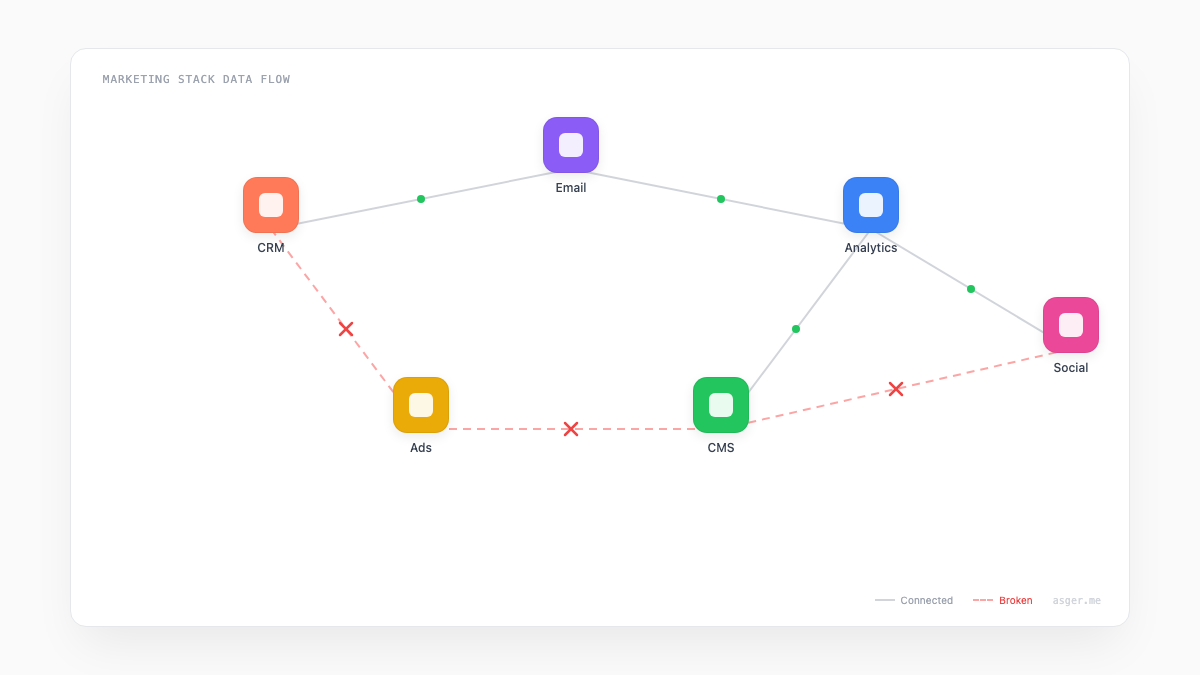
The Monday export is part of the system
Someone opens the ad platform, exports a file, changes three column names, joins it to the CRM export, and updates the report.
The diagram says the tools are integrated.
The person doing that weekly repair knows the truth.
Manual work is not automatically bad. A deliberate review can be exactly the right control. The problem is manual work nobody has named, owned, or documented. That is when a colleague quietly becomes the integration between two expensive systems.
Start with one decision
I do not begin a stack review by listing every tool.
I begin with a decision the team struggles to make. Which campaign is creating useful pipeline? Which accounts need sales attention? Where are qualified enquiries getting lost? What can we safely stop spending money on?
Then I work backwards through the numbers and systems behind that decision.
What does the dashboard count? Which CRM field supplies it? What changes that field? Where did the record enter? Which manual correction happened in between?
This keeps the investigation tied to work somebody actually needs to do.
Different numbers can all be correct
An ad platform counts its event. The CRM counts a contact or opportunity. Finance counts revenue. They are not looking at the same moment.
The problem is not that the numbers differ. The problem is that nobody can explain the difference, or the team switches definitions depending on which result looks nicest.
Write down the decision, the metric used for it, the definition, the source system, and the owner. Then record the expected delays and exclusions.
That small amount of agreement is more useful than another dashboard.
One shared definition beats three beautifully automated misunderstandings.
Follow the handovers
Most breaks live between tools and teams.
The website sends the form, but not the campaign context. The CRM creates the record, but the lifecycle stage means something different to marketing and sales. Product usage reaches a warehouse, but not the person planning the next account campaign.
At each handover I ask what moves, what does not, who notices an error, and what a person does when the automation is wrong.
Sometimes a native integration is enough. Sometimes a small automation or script closes the gap. Sometimes the real fix is agreeing ownership and removing a field nobody should have relied on.
Tool choice comes after that.
Agents make the checking repeatable
This work involves a lot of comparison: exports, field definitions, tracking plans, workflow histories, and the documentation everybody hopes is current.
I use agents to prepare those comparisons, trace likely mismatches, rerun checks, and keep the system map beside the work. They are good at carrying the repetitive part of the investigation.
They do not decide which number the board should use or whether a manual review is commercially worth keeping. That judgment stays with the team.
When a repeated handover needs a narrow tool rather than another subscription, I can build and test that too.
Fix the spine before the edges
Once the path behind the decision is visible, start where the flow loses trust.
That may be the campaign-to-website tracking, the website-to-CRM capture, the lifecycle handover to sales, or the definition feeding management reporting. Fix and test one part before changing the next.
Document what owns the data, how it moves, and what to check when it looks wrong.
The goal is not a perfectly connected stack. It is a setup the team can understand well enough to make a decision and change safely.
If the weekly report still depends on somebody remembering the ritual, send me the flow.